Introduction: Why Three Letters Can Say So Much
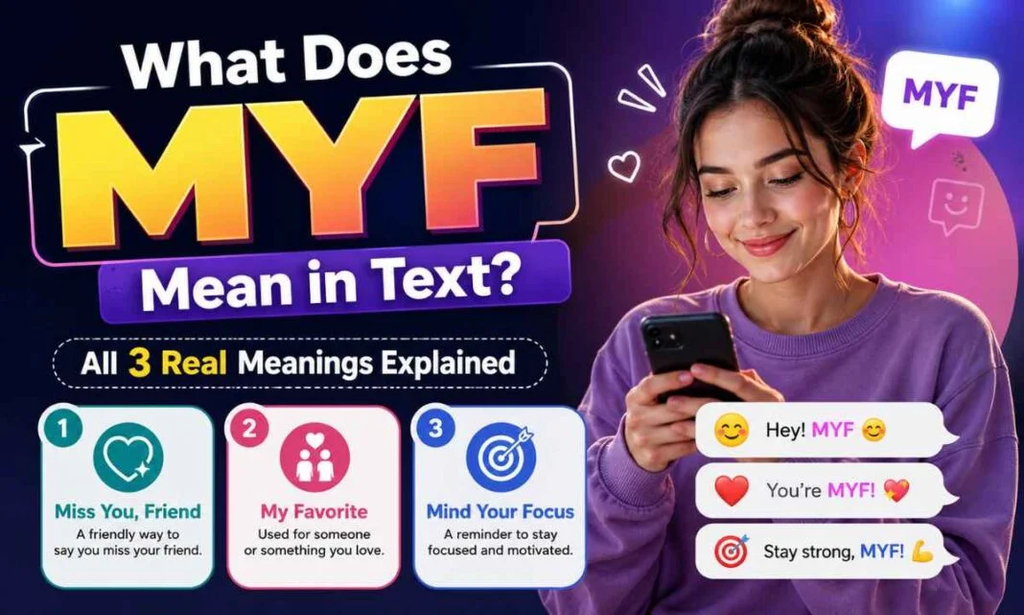
myf meaning begins with a simple problem of modern communication: three letters can carry several different emotions. In casual digital conversations, MYF may be understood as “My Friend,” “My Fault,” or “Miss Your Face,” depending on the people speaking and the surrounding message. Unlike highly standardized abbreviations such as LOL or BRB, MYF has no single universal definition. Therefore, understanding the conversation around it is often more important than memorizing one fixed translation.
The Most Familiar Reading: MYF as “My Friend”
For many casual conversations, MYF is used as a compact form of “My Friend.” It can appear when someone addresses a friend directly or refers to a person in an informal exchange. For example, a message such as “Thanks, MYF” carries a relaxed sense of familiarity without requiring a full sentence. Moreover, this usage reflects a broader feature of internet language: people regularly compress ordinary expressions into shorter forms when communicating quickly through phones, social platforms, and private messaging.
When MYF Means “My Fault”
Another established interpretation is “My Fault,” particularly when someone wants to acknowledge a small mistake without making the conversation overly serious. A person might write MYF after forgetting something, sending incorrect information, or misunderstanding a message. In this setting, the abbreviation functions almost like “my bad” or “that was on me.” Interestingly, user-generated slang records contain examples of this interpretation, including entries dating from the early 2020s.
The More Affectionate Side: “Miss Your Face”
Among the warmer interpretations, “Miss Your Face” gives the abbreviation an entirely different emotional character. Instead of accepting responsibility, the sender is expressing affection or longing for someone’s presence. The phrase can feel playful between friends, sentimental between relatives, or mildly romantic between partners. Notably, user-generated records document this usage as far back as 2009, although that does not establish a definitive origin date. It does, however, demonstrate that the expression predates today’s social-media vocabulary.
myf meaning Depends on the Conversation Around It
The most useful way to understand MYF is to treat it as contextual language rather than a dictionary-style word. Consider the sentence surrounding the abbreviation, the relationship between the participants, and the emotional direction of the conversation. If someone is apologizing, “My Fault” may be obvious. If someone is reminiscing about a friend, “Miss Your Face” becomes more plausible. Meanwhile, if MYF appears as a friendly form of address, “My Friend” may be the natural interpretation. Context effectively completes the meaning.
Digital Language Has Become Highly Situational
Internet communication has changed the relationship between words and meaning. Traditionally, a word could be understood primarily through a dictionary definition, while digital shorthand often depends on community, platform, timing, and tone. Consequently, the same abbreviation can move between different meanings without users considering the change unusual. MYF illustrates this beautifully. Its flexibility is not necessarily a weakness; rather, it demonstrates how online language behaves more like living conversation than a fixed vocabulary. Meaning is negotiated between people in real time.
A Small Abbreviation Can Carry Different Emotions
One reason the abbreviation attracts attention is that its possible interpretations occupy very different emotional spaces. “My Friend” is warm and familiar, “My Fault” accepts responsibility, while “Miss Your Face” expresses emotional attachment. Therefore, guessing incorrectly can produce an awkward response. Imagine receiving an apologetic message and interpreting MYF romantically, or reading an affectionate message as an admission of fault. The letters remain unchanged, yet the emotional meaning shifts dramatically. This is precisely why digital literacy increasingly involves understanding tone as well as vocabulary.
How Social Platforms Encourage Shorter Expressions
Messaging platforms have helped normalize compressed language. Instagram DMs, Snapchat conversations, TikTok comments, Discord chats, and ordinary text messages reward speed and informality. Users often communicate through abbreviations, emojis, shortened phrases, and inside jokes because these forms resemble spoken conversation more closely than formal writing. As a result, MYF fits naturally into an environment where people prioritize immediacy and personality. However, popularity on one platform does not guarantee that every community will interpret the abbreviation in exactly the same way.
Reading MYF Without Misunderstanding the Sender
A practical approach is to read the entire message before interpreting the abbreviation. First, identify whether the sender is apologizing, greeting you, reminiscing, joking, or discussing another person. Next, consider your relationship with that person. Finally, look at the platform and any emojis or surrounding expressions that might establish tone. If the meaning remains unclear, asking is usually better than assuming. A short question can prevent an unnecessarily complicated misunderstanding, especially when the possible meanings have completely different emotional implications.
A Quick Guide to the Main Interpretations
| Interpretation | Emotional tone | Typical situation |
|---|---|---|
| My Friend | Friendly and familiar | Greeting or addressing someone |
| My Fault | Apologetic and accountable | Admitting a mistake |
| Miss Your Face | Affectionate and personal | Missing someone’s presence |
This comparison shows why MYF should not automatically be translated into one phrase. The abbreviation is better understood as a small linguistic container whose meaning comes from context. Some online sources emphasize “My Friend,” while others highlight “Miss Your Face” or “My Fault.” The disagreement itself is revealing: internet abbreviations are often shaped by separate communities rather than controlled by a single linguistic authority.
Why Ambiguous Slang Survives
At first glance, ambiguous abbreviations might seem destined to disappear because they can confuse readers. Yet ambiguity can actually help slang survive. Friends may understand an abbreviation because they share habits, jokes, or cultural references that outsiders do not recognize. In that sense, MYF can become a marker of familiarity. Furthermore, digital language frequently rewards expressions that feel personal rather than perfectly standardized. What matters is not always universal comprehension; sometimes the purpose is to communicate efficiently within a particular social circle.
The Difference Between Private and Public Language
The setting also determines whether an abbreviation feels appropriate. In a private group chat, MYF can seem effortless and natural. On a public-facing professional website, however, unexplained shorthand may appear unclear or informal. Therefore, good communication is not simply about knowing what an abbreviation means; it is about knowing when to use it. A professional email, customer-service message, academic assignment, or formal announcement generally benefits from complete wording. Casual slang belongs where the audience already understands its conventions.
How to Reply When Someone Sends MYF
The safest response depends on the apparent meaning. If the message is clearly affectionate, a warm response can maintain the emotional tone. If the sender is admitting a mistake, reassurance or a simple acknowledgment may be appropriate. If the abbreviation appears as a friendly address, responding normally is usually enough. When nothing provides a clear clue, asking what they mean is entirely reasonable. Digital communication often moves quickly, but clarity still matters. In fact, a brief clarification can preserve a relationship better than an incorrect assumption.
The Cultural Story Behind Tiny Text Abbreviations
There is a larger cultural lesson hidden inside small expressions such as MYF. People have always shortened language when communities develop shared communication habits, from nicknames and initials to professional jargon and regional expressions. Digital culture has simply accelerated that process. Now, a phrase can emerge inside one group chat, spread through a platform, and acquire new meanings elsewhere. Consequently, slang is not merely a collection of shortcuts. It is evidence of how communities create identity, intimacy, humor, and belonging through language.
myf meaning Is Ultimately About Context
The deeper significance of myf meaning is therefore not one definitive expansion but the way context shapes digital speech. The abbreviation may represent friendship in one exchange, accountability in another, and affection somewhere else. Because online language is constantly being adapted by its users, rigid definitions can sometimes create more confusion than clarity. Instead, readers should look at the complete message, the relationship between participants, and the emotional setting. Once those clues are considered together, the three letters become considerably easier to understand.
Conclusion: Meaning Lives Between the Lines
Ultimately, MYF demonstrates how modern communication can compress complicated social signals into remarkably small expressions. Three letters may acknowledge a mistake, express affection, or simply address someone as a friend. Yet the real meaning rarely exists in the letters alone. It emerges from tone, relationship, timing, platform, and shared understanding. That makes MYF more than a texting abbreviation; it is a small example of language continuously evolving around human connection. In an age of rapid digital conversation, sometimes understanding what was meant requires looking beyond what was written.